Mount Rainier Radio Control Society
Code of Conduct - Field and Flying Rules - MARCH 2026
MRRCS / Pfeiffer Field is much more than just a place to fly model airplanes. Rather, it is viewed by the current membership as a highly enjoyable and picturesque place to fly our many different flying machines.
It is also a place where club members with a common aero-modeling interest can gather socially & share technical knowledge, train novice pilots, and enjoy camaraderie & fellowship amongst all members who wish to enjoy this wonderful hobby.
All club members are expected to make safety their top priority and treat others—including fellow members, neighboring landowners, visitors to the field, and the public—with honesty, courtesy, cooperation, and a positive attitude.
CODE OF CONDUCT
As members of Mount Rainier Radio Control Society:
We represent ourselves and our club to the general public in a friendly and courteous manner.
We are considerate and respectful of all other club members.
We encourage creativity and the sharing of solutions for technical problems of our hobby.
We promote safety in all aspects of our hobby.
We participate in and conduct all club business ethically, with integrity and in accordance with our bylaws.
We support the management of our club with enthusiasm & creativity, while adapting to changing times.
We do not publicly engage in any personal dispute with another member at the flying field or other club functions, but attempt to resolve such issues in private.
We do not use abusive or obscene language.
We do not behave in a threatening or aggressive manner.
We do not behave in an un-sportsman-like or discourteous manner.
We do not come to the field or any club function under the influence of alcohol or intoxicating drugs.
FIELD AND FLYING RULES
Security
Member's keys fit the gate lock, the well house lock, and the two outside water hydrant locks.
The person opening the gate shall insert the lock in the bolt and close the lock while gate is open.
THE LAST PERSON TO LEAVE THE FIELD IS RESPONSIBLE TO ENSURE THAT ALL AREAS ARE SECURE.
Identification
Members shall wear their club identification badge on their person all times when at the field.
ID should be easily visible to others. ID will consist of their current AMA membership card with a current-year club sticker, or other such ID issued by the club.
Radios and Frequency Control
Only frequencies authorized by the Federal Communications Commission will be used for control of aircraft.
All flight training shall be accomplished by use of a “buddy box” either electronic or trainer cord with an instructor having the master control transmitter. This requirement shall exist until the instructor is satisfied the student can safely fly the aircraft.
Legacy Radios (72mhz & 53 mhz frequencies): No radio will be turned on unless the appropriate frequency pin is attached. If a club trainer box is used, the pin for the slave radio is not required. If other than a club trainer box is used, the pin for both the slave and master are required. Newly installed radios and radios involved in a crash will be range checked before flight.
Safety
The Official AMA National Model Aircraft Safety Code and Related Safety Programs shall govern all operations. A copy is posted in the clubhouse and each AMA member receives a copy from AMA when the annual membership is renewed.
Pilots will not operate any model aircraft while under the influence of alcohol or any drug that could adversely
affect the ability to safely control the model. *AMA PUB 105 - item#3 & AMA PUB100 pg 3, item#3
Pilots will not fly any model aircraft in a careless or reckless manner, and will avoid flying directly over
unprotected people, moving vehicles, and occupied structures. *AMA PUB 105 - item#1 & AMA PUB100 pg 3, item#1
A fire extinguisher must be available when gasoline and turbine engines are operated.
Models may be taxied only from the yellow line on the run-up pad to the runway. Taxi from the runway to the run-up pad or the pits is prohibited.
Please DO NOT FLY OVER ACTIVE LAWNMOWERS or other tractors/equipment. Take caution when
ANY lawnmowers or other grounds equipment are active anywhere at the field. Do not attempt to fly if
any such equipment is in active use on or directly around the runway - including the over-runs. If
equipment is being operated on the “flying side” of the YELLOW FLIGHT LINE - please wait until it is
clear to fly. **
All persons not involved in model operations must remain behind the fence line or in the sunshade. Spectators desiring to visit the pit area may do so on request and if accompanied by a club member. Only pilots, instructors, callers, or spotters are allowed on the flight line; no more than two persons per pilot station. All persons 16 years of age or under will be accompanied by a parent or guardian.
Pets must be restrained and kept on the parking lot side of the fence line. Please pick up after your pet. Messes and aggressive behavior will not be tolerated.
Flight Operations
Only four fix-winged, powered aircraft may be airborne at the same time.
Pilots will use the marked pilot boxes.
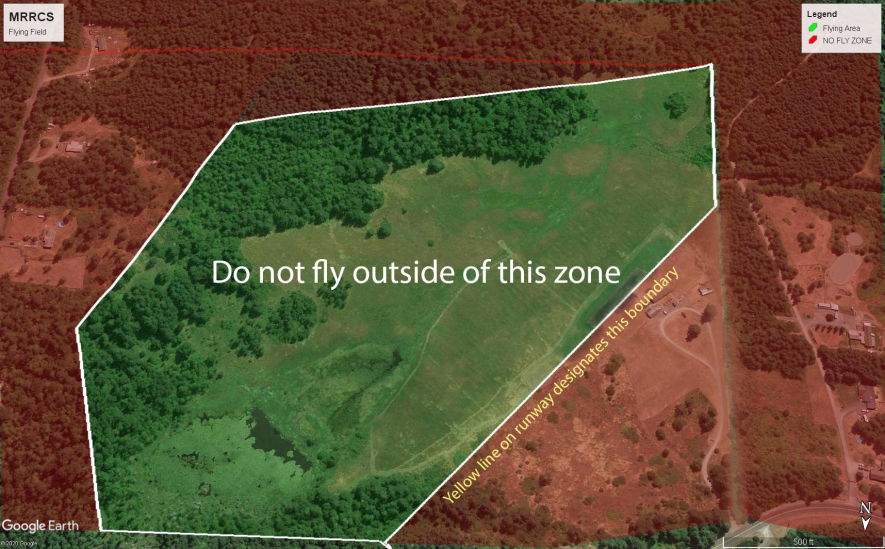
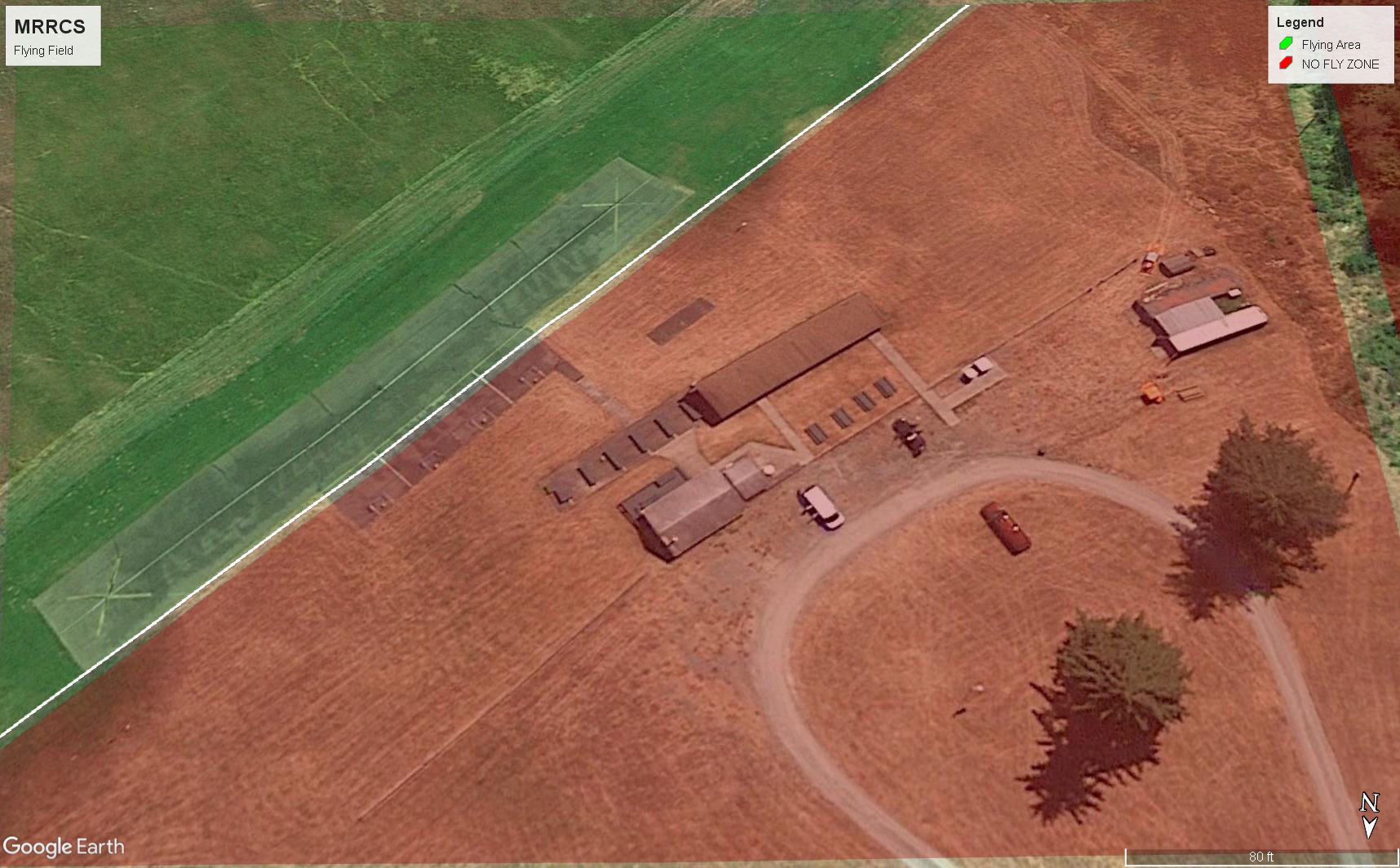
All flying will be conducted on the open field side of the yellow safety line (the near edge of the asphalt runway) and within club property boundaries.
Use of the grass strip and grass overruns is permitted at anytime, but pilots must remain in the marked pilot boxes unless no other aircraft are in flight.
If a helicopter is already flying, all other aircraft must get permission to fly from the helicopter pilot before they proceed.
Pilots will announce take off, touch and go, and landing operations. If necessary to cross the runway or retrieve a model from the runway, other pilots will be informed prior to doing so.
With prior notification to, and agreement from other flyers, hand launching may be accomplished from any position on the open field side (south) of the yellow safety line and in any direction other than towards the yellow safety line. All other flight operation rules apply.
Aircraft may be taxied only from the yellow line on the run-up pad to the runway. Taxi from the runway across the yellow line toward the pilot or pit area is prohibited.
Please follow the AMA & FAA guidelines for FPV flight (any platform.)
The FAA requires your FAA Registration Number on the outside of all flying aircraft, and your TRUST Test Certificate available when flying.
Turbine Operation
Pilot must have the appropriate AMA waiver to operate all turbine engines.
Aircraft with turbine engines are welcome except for the period when Pierce County imposes a fire danger ban. Pilots shall consult with the South Pierce County Fire District on the day of operation to determine any specific fire danger.
A water fire extinguisher supplied by the pilot will be required in the presence of turbine operation.
Please see additional rules for Turbine Waiver & Aircraft in following sections of MRRCS-Field & Flying rules.
Helicopter Flight Rules
Helicopter pilots must follow all of the same AMA and MRRCS flight rules as fixed wing aircraft pilots.
Helicopter pilots must get permission to fly from all fixed wing pilots who are already in the air before they proceed beyond the yellow safety line. If a helicopter is already flying, all other aircraft must get permission to fly from the helicopter pilot before they proceed.
Helicopters must take off and land from the center of the paved runway while the pilot stands in an established pilot box.
Fixed wing aircraft have the right of way over helicopters anytime they share MRRCS air space.
All helicopter flight operations must be conducted over the grass beyond the far edge of the runway.
Only one helicopter pilot shall be permitted to fly anytime there are fixed wing aircraft already in the air.
Combat Rules
Members will be allowed to have unlimited pilots for RC combat. Pilots must stay behind the yellow safety line until the last plane lands. The planes must stay on the far side of the paved runway while in the air.
No other planes will be allowed to fly while the combat session is going, combat planes only.
General
Extended engine operation for break in or extended tuning will be accomplished in the vicinity of the green and brown sheds.
Internal combustion engines will not be operated before 8 A.M. Acceptable engine noise is 96 dB, or less, at 9 feet at full throttle.
No open fires except in the approved fire pit. A connected water hose must be at the ready. All fires must be extinguished before leaving the field.
Extended RV Parking or Camping is limited to a two-week stay, unless otherwise approved by the Board Members.
Additional MRRCS Turbine Waiver Holder Rules and Guidelines effective Oct. 2025
*All appropriate MRRCS, AMA, and FAA rules apply to Turbine Waiver Holders*
SEE:https://www.modelaircraft.org/system/files/documents/510-A.pdf
TWH = Turbine Waiver Holders ..... TWG = Turbine Waiver Holders Group (TWH & Board of Directors)
Turbine Waiver Holders Group :
The TWG will be all turbine waiver holders in the MRRCS membership, along with a minimum of one (but not limited to one) of the Board of Directors that are willing to participate in keeping the turbines safe to fly at MRRCS / Pfeiffer Field. They will keep the turbine rules up to date, with the final approval from the club.
The Turbine Waiver Holders will decide who will be the inspector(s) and will be responsible for keeping track of all of the waiver holders and their requirements.The TWG group will establish a means of communication: email, text, phone list. The TWG will meet at least once a year, or more as needed. All TWG members are encouraged to help with inspections and help others learn, this will help make all of our planes safer at MRRCS / Pfeiffer Field.
1.(A) Turbine airframe should be indicated as "Designed For Turbine Use" by the designer (kit/plan built) or the manufacturer (ARF).
(B) EXCEPTION: All turbine aircraft that do not meet the "Designed For Turbine Use" by the designer or the manufacturer rule 1.(A) above. Including "Scratch Built," will be required to be inspected by the designated TWH inspectors every 25 flights as documented in the required log book. Scratch built turbine aircraft will be approved on a case by case basis by the MRRCS Turbine Waiver Holders Group. (TWG)
2. Maiden flights, or test flights following a major repair of the aircraft structure, propulsion system, or control system will NOT be performed at MRRCS. Ground testing of brakes, steering, engine, or safety shutoff is allowed.
3. Aircraft must have no less than 10 documented flights by the same pilot at an alternate field to prove and to learn the aircraft before flying it at MRRCS.
4. An inspection of ALL turbine aircraft is required prior to flying at MRRCS. Inspections will be done by a qualified member of MRRCS that was selected by the MRRCS Turbine Waiver Holders. A daily preflight is required.
5. MRRCS requires the pilot to be an Experienced Gas Turbine Pilot and will keep a current logbook per AMA document 510-A.
6. A Turbine pilot that is new to turbines or new to MRRCS will be required to be under direct supervision of an "Experienced Turbine Pilot" for ONE Year while flying a Turbine Powered Aircraft at MRRCS.
7. Guest turbine pilotsmust follow the same rules & inspections as members. The guest must have a MRRCS Turbine pilot as a sponsor to fly at MRRCS.
8. Do Not takeoff if another "Non Turbine Aircraft" is in the air. All non turbine aircraft will NOT takeoff if a "Turbine Aircraft" is in the air. You must communicate with all pilots and spotters.
9. Turbine Pilot shall fly with a spotter.